WHY DATAFORMLY
Importing data is easy. Preparing it properly is not.
Your ERP or e-commerce platform can import product data. The real challenge is getting that data into a reliable, structured, and e-commerce ready state before it reaches the platform.

NATIVE IMPORT VS DATAFORMLY
Importing is not the hard part.
Preparing trustworthy product data at scale is.
Native batch import tools are useful, but they assume your data is already clean, structured and ready. Dataformly automates the work required before the import, so you can publish reliable product information.

Native batch import
Moves data that is already prepared.
Correct format required
Field mapping already defined
Duplicates already handled
Values already normalized
Content already checked
Data already ready to publish

Dataformly
Prepares and governs data before integration.
Reads multiple source types
Interprets and structures information
Normalizes attributes and terminology
Detects inconsistencies and duplicates
Flags exceptions for review
Prepares multilingual outputs
WHY DATAFORMLY ADDS
From fragmented information
to commerce-ready product data.

Interpret & structure
Turn fragmented information from any source into consistent product model.

Validate & govern
Resolve inconsistencies, detect duplicates and flag uncertain cases before publishing.

Reuse & scale
Apply the same configured workflow to future batches, updates, and catalogue growth.
BUSINESS OUTCOMES
Less manual work. Better catalogue operations.
DataFormly helps turn catalogue preparation from a repeated manual task into a controlled, reusable workflow.

Faster product onboarding
Reduce the time from raw data to published products.

Lower manual preparation
Automate repetitive and error-prone tasks.

More consistent catalogue data
Improve data quality and reduce exceptions.

Easier multilingual expansion
Generate and maintain content across multiple languages.
PLATFORM-NATIVE PRINCIPLE
Built for your platform.
Not around it.
DataFormly adapts to the native architecture of your ERP, PIM, and e-commerce platform. It uses supported import methods, APIs or connectors without forcing a parallel catalogue structure or bypassing your system's own data model.
Automation where possible. Validation always. Human review where necessary.
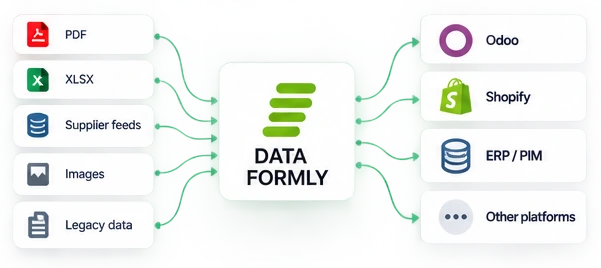
Batch import is useful once your data is already clean, structured, mapped and validated. DataFormly automates the work required before that point: interpreting source information, normalizing it, checking for inconsistencies and duplicates, enriching missing content, and preparing it for reliable import.
No. DataFormly is designed to work with your existing systems, not replace them. It adapts to the native architecture of your ERP, PIM or e-commerce platform and uses the appropriate import methods, APIs or supported integrations.
Depending on the project, DataFormly can work with structured and unstructured sources such as PDFs, spreadsheets, supplier files, product images, feeds, APIs, existing ERP records and legacy catalogue data.
Yes. AI can support tasks such as interpretation, structuring, enrichment, content generation and multilingual output. But DataFormly is not an uncontrolled AI content tool: validation, business rules and human review remain part of the process.
DataFormly checks the information before it reaches the target platform. Where a discrepancy can be resolved safely, it can be handled automatically. Where confidence is insufficient, the issue is flagged for review instead of being published blindly.
Yes. Multilingual content can be generated and maintained as part of the same workflow, while preserving technical terminology, product identifiers and other values that require controlled handling.
The core DataFormly framework is reusable, but each implementation is configured around the customer’s source data, catalogue structure, business rules and target platform. Some integrations may require additional technical work depending on the systems involved.
DataFormly is configured around the target platform’s data model and product-page structure. It maps product information to the appropriate fields, attributes, sections and relationships so the output fits the way the platform expects products to be built.
Yes. Product images can be associated with the correct products and prepared for use in the target catalogue. Depending on the implementation, this can include resizing, format handling, naming, ordering and linking images to the appropriate product records.
Technical documents can be checked, associated with the correct product and prepared for upload to the target platform. The workflow can also validate naming, product references and other document-related rules before publication.
Yes. The objective is to work with the platform’s existing structure rather than impose a new one. DataFormly maps the processed information into the native fields and content areas defined by the customer’s catalogue and page architecture.
Yes, provided the relevant identifiers and update rules are available. The workflow can distinguish between creating new records and updating existing ones, helping avoid unnecessary duplication.
Yes. One of the advantages of the workflow is that product information, images and technical documentation can be processed together and associated with the correct product before integration.
Yes. The workflow can be presented through a simple operator interface designed around clear actions such as uploading source material, running a batch, reviewing exceptions, approving results and publishing validated data. Users do not need to interact directly with scripts, APIs or code.
Once an implementation is configured, the process is designed to be straightforward: upload or select the source data, run processing, review anything that has been flagged, approve the result and send the validated information to the target platform.
FREQUENTLY ASKED QUESTIONS
Common questions.
Clear answers.
READY TO SEE DATAFORMLY IN ACTION?
Send us a sample product file.
We'll show you the results.
PDFs, spreadsheets, images or any product data.